
Choosing among top Lead Glasses manufacturers in China takes more than comparing prices or polished product photos. Buyers should examine lens materials, frame fit, weight, documented attenuation, and quality-control records. Small details matter: a nose bridge that slips during a procedure can make otherwise well-made glasses uncomfortable to wear.
Medical physicist John R. Cameron’s work offers a useful principle, paraphrased here: judge radiation protection by verified performance, not appearance. This is not a direct quotation. A trustworthy supplier should provide clear product specifications and supporting test information, while explaining how its products are intended to be used. Ask about customization, replacement parts, production consistency, and after-sales support. Then compare answers, not just catalogs.
Some questions are easy to overlook. For example, does the quoted specification apply to the complete lens, or only its material? And are test documents traceable to the product being offered? These details deserve careful review. This guide introduces notable Chinese manufacturers and practical criteria for assessing them, including product range, technical transparency, and service. It does not treat marketing claims as proof. No single supplier suits every clinic or buyer; fit, application, and independently verifiable documentation should shape the decision. Manufacturers may also differ in what they disclose. That can make comparison imperfect, and readers should verify current details directly before purchasing.
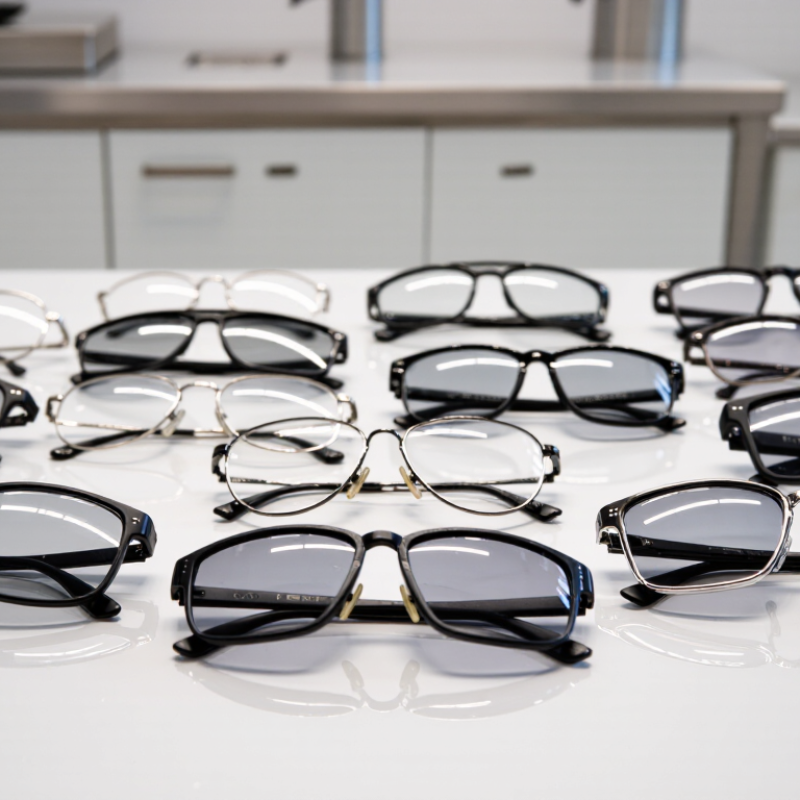
Lead glasses are protective eyewear with lead-equivalent lenses designed to reduce exposure from scattered X-rays. They are used in settings such as medical imaging rooms, where staff may work near active equipment. The lenses absorb part of the scatter before it reaches the eye. They do not make exposure disappear.
Fit matters. The International Atomic Energy Agency’s guidance on radiation protection of medical staff reports that well-fitted lead glasses can reduce eye-lens exposure by roughly five to ten times. Actual protection varies with frame design, side coverage, fit, and the direction of incoming scatter. A gap near the temple can let radiation reach the eye. Not magic.
The International Commission on Radiological Protection, in Publication 118, recommends an occupational eye-lens dose limit of 20 mSv per year, averaged over five years, with no single year above 50 mSv. This benchmark helps explain why eyewear belongs within a broader protection plan, alongside distance, shielding, and dose monitoring. It is easy to assume the lenses alone are enough; they are not. Check that they sit securely and provide side protection.
| Topic | General information | What to check |
|---|---|---|
| What lead glasses are | Protective eyewear with radiation-attenuating material in the lenses and, in some designs, the side shields. | Confirm which parts of the eyewear provide shielding; ordinary prescription glasses are not radiation-protective eyewear. |
| How protection works | The shielding material attenuates some incident X-rays, reducing exposure to the eyes. The amount depends on the beam energy, material, thickness, and geometry. | Lead-equivalence values are not a guarantee of identical performance in every X-ray beam; check the test conditions and documentation. |
| Lens material | Some protective eyewear uses leaded glass; other designs use radiation-attenuating polymer materials. Material choice affects weight, optical properties, and design. | Review the product’s lens material, optical quality, prescription options, and care instructions. |
| Lead equivalence | Products are commonly described by a lead-equivalence rating, such as 0.50 mm Pb. The rating indicates attenuation relative to lead under specified test conditions. | Request a test report that identifies the rated components, measurement method, and radiation conditions. Do not compare ratings without checking those details. |
| Side protection | Side shields can help reduce exposure from radiation arriving from the side, depending on their coverage and shielding specification. | Check whether side shields are included and whether their shielding rating is specified separately from the lenses. |
| Typical work settings | May be used by trained personnel in settings involving medical or dental X-ray procedures, fluoroscopy, or other occupational X-ray work, as part of a radiation-protection program. | Select eyewear according to the work task and the facility’s radiation-safety assessment. |
| Fit and coverage | A close, comfortable fit helps keep the eyes within the intended protected area. Prescription inserts or prescription protective eyewear may be available. | Check coverage around the eyes, compatibility with other protective equipment, and fit while performing the actual task. |
| Limitations | Protective glasses reduce exposure to the eyes but do not eliminate radiation exposure and do not protect the rest of the body. | Use them alongside appropriate shielding, safe work practices, and other required protective equipment; they are not a substitute for barriers. |
| Inspection and care | Scratches, cracks, loose components, or damaged frames can affect usability and may compromise coverage. | Inspect regularly, clean according to the manufacturer’s instructions, and remove damaged eyewear from service for evaluation. |
| Supplier evaluation | A reliable supplier should provide clear specifications and supporting product documentation for the exact eyewear model offered. | Compare documented lead equivalence, lens and side-shield coverage, optical quality, fit options, quality-control records, and warranty terms—not claims alone. |
Note: Specifications and protective performance vary by product. Verify current documentation for the exact model and consult the facility’s radiation-safety professional when selecting eyewear.