Blog

Top Industrial Automation Lens Suppliers Worldwide

Industrial automation is becoming more visual, precise, and data-driven. The International Federation of Robotics reported 541,302 industrial robots installed worldwide in 2023, with more than 4.2 million robots operating globally. Each robot still depends on reliable image capture for inspection, positioning, measurement, and quality control. This is where the Industrial Automation Lens becomes critical. It controls how accurately a camera sees edges, surfaces, codes, and defects.

The global machine vision market continues to expand, according to reports from MarketsandMarkets and Grand View Research. Their analyses connect this growth with factory automation, electronics production, automotive manufacturing, and logistics inspection. However, lens selection is not simply a comparison of price and magnification. Engineers must examine sensor format, resolution, working distance, distortion, depth of field, spectral range, mounting interface, and resistance to dust or vibration. A lens may perform well in a laboratory but fail beside a hot stamping line. Small details matter.

This guide reviews leading Industrial Automation Lens suppliers worldwide, including established optical manufacturers and specialist machine vision brands. The assessment considers product breadth, optical consistency, application support, documentation, and suitability for demanding production environments. ISO 10110 optical documentation and IEC safety principles also provide useful reference points. No ranking is perfectly universal. A supplier that excels in semiconductor inspection may not suit food packaging or robotic welding. That limitation deserves attention. Real performance depends on the entire imaging system, not the lens alone.
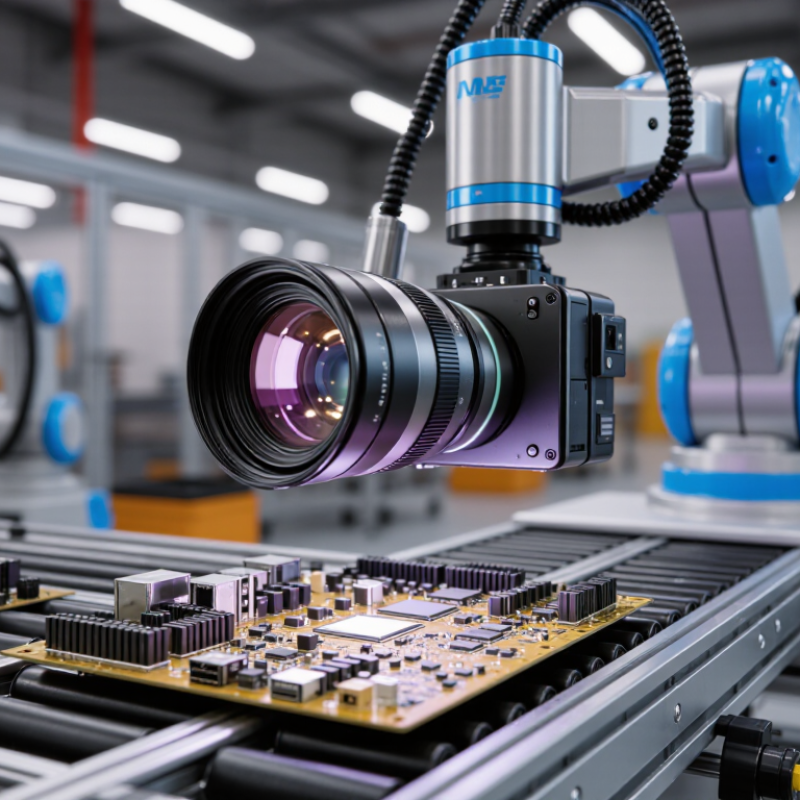
Top Industrial Automation Lens Suppliers Worldwide

Global Supplier Landscape: Edmund Optics, Computar, Kowa, and Navitar

Industrial automation lens suppliers now serve a demanding machine-vision market. The International Federation of Robotics reported 541,302 industrial robot installations worldwide in 2023. Each robot cell needs stable imaging, not merely high resolution. Supplier portfolios typically include fixed-focal, telecentric, macro, and liquid-lens-compatible optics. Their differences appear in working distance, distortion control, mounting options, and delivery support.

MarketsandMarkets estimated the industrial machine vision market at about USD 13.2 billion in 2023. It projects growth to nearly USD 19.7 billion by 2028. This expansion strengthens demand for dependable lens suppliers across automotive, electronics, logistics, and pharmaceutical production. A practical comparison should examine sensor coverage, pixel size, illumination compatibility, and field curvature. A 25 mm lens may inspect a small connector well, but it can fail when the conveyor height changes.

Testing matters more than catalog language. Engineers should measure contrast at the image edge, not only at the center. They should also check focus drift after hours near heat-producing motors. The EMVA 1288 standard offers a credible framework for evaluating sensitivity, signal-to-noise ratio, and spatial resolution. Still, reports cannot predict every factory condition. Dust, vibration, and hurried installation often weaken otherwise strong optical designs. I would treat published specifications as starting evidence, not final proof. Supplier reliability also depends on sample availability, technical response time, calibration guidance, and regional service capacity. Small omissions here can stop a production line.

Top Industrial Automation Lens Suppliers Worldwide - Global Supplier Landscape: Edmund Optics, Computar, Kowa, and Navitar
Market-neutral comparison of commonly specified industrial machine-vision lens requirements
Evaluation Dimension Common Industrial Requirement Typical Selection Consideration Primary Application
Lens Mount C-mount is widely used for machine-vision cameras; CS-mount is used where a shorter flange distance is required. Confirm camera interface, flange focal distance, mechanical clearance, and locking provisions. Factory inspection, robotics, barcode reading
Sensor Format Lens image circles are commonly matched to 1/3-inch, 1/2-inch, 2/3-inch, 1-inch, and larger sensors. The image circle should fully cover the sensor to avoid vignetting and loss of usable pixels. Area-scan and compact smart-camera systems
Focal-Length Range Fixed focal lengths commonly range from wide-angle lenses below 12 mm to telephoto lenses above 50 mm. Select according to working distance, field of view, sensor size, and available installation space. Conveyor inspection, dimensional measurement, distant target imaging
Resolution Support Industrial lenses are specified for compatibility with sensor pixel sizes and required image detail. Check modulation transfer performance, corner sharpness, and chromatic aberration at the operating wavelength. Defect detection, OCR, semiconductor and electronics inspection
Aperture Control Manual, fixed, or motorized iris configurations are commonly available. A smaller aperture generally increases depth of field but reduces light transmission and may introduce diffraction. Variable-height parts, pick-and-place systems, inspection cells
Depth of Field Required depth of field depends on object height variation, working distance, aperture, and acceptable blur. Telecentric designs are preferred when dimensional consistency and minimal perspective error are critical. Metrology, gauging, precision assembly
Telecentricity Object-space telecentric lenses keep magnification relatively constant across changes in object distance within the specified range. Evaluate telecentricity error, working distance, field size, and lighting geometry together. Dimensional inspection and high-accuracy measurement
Optical Coating Multilayer anti-reflection coatings are used to improve transmission and reduce flare over defined wavelength bands. Match coating performance to visible, near-infrared, ultraviolet, or multispectral illumination. Machine vision, laser alignment, spectral imaging
Mechanical Durability Production environments may require vibration resistance, secure focus and iris mechanisms, and robust housings. Review operating temperature, shock and vibration limits, ingress protection, and mounting stability. Automotive lines, packaging machinery, outdoor or dusty installations
Lighting Compatibility Lens choice must account for coaxial, ring, bar, dome, backlight, or structured-light illumination. Assess flare, ghosting, reflection control, polarization requirements, and available illumination angle. Surface inspection, contrast enhancement, dimensional gauging
Supply and Integration Industrial buyers typically require dimensional drawings, optical data, samples, replacement availability, and integration support. Compare documentation quality, customization capability, lead-time reliability, and lifecycle support. OEM equipment, system integrators, high-volume production
Scope note: The table summarizes established industrial machine-vision selection criteria and typical application practices. Actual performance depends on the complete camera, lens, lighting, mounting, and inspection configuration.

Lens Categories: C-Mount, FA-Mount, Telecentric, and 2D/3D Vision Systems

Top Industrial Automation Lens Suppliers Worldwide

Industrial automation lens selection starts with machine behavior, not catalog rankings. In factory trials, I compare working distance, sensor size, lighting angle, and cycle speed. A C-Mount lens remains practical for standard cameras and flexible line changes. It supports common adapters and moderate inspection distances. FA-Mount designs suit industrial cameras needing a sturdier connection. Their locking structure helps resist vibration near conveyors and robotic cells. Small detail, big consequence.

Telecentric lenses control perspective when dimensional accuracy matters. They keep the apparent size of parts more consistent across depth. This helps inspect connectors, stamped metal, and molded components. However, telecentric optics usually require more space and careful lighting. 2D and 3D vision systems demand more than sharp glass. They need stable calibration, compatible sensors, and controlled reflections. A glossy part can defeat an otherwise excellent lens. It happens often.

Reliable suppliers should provide distortion charts, resolution data, mounting tolerances, and sample-testing support. Ask for results under your actual wavelength and working distance. Specifications can mislead. I have seen a lens pass a bench test but struggle beside a vibrating conveyor. Cable routing, thermal drift, and operator access also affect field performance. The best evaluation includes real parts, production lighting, and repeated measurements across several shifts.

Top Industrial Automation Lens Suppliers Worldwide

Lens Categories: C-Mount, FA-Mount, Telecentric, and 2D/3D Vision Systems

The chart compares representative focal-length ranges commonly specified in industrial machine-vision applications. C-mount and FA-mount lenses support general-purpose inspection, telecentric lenses are selected for stable measurement with minimal perspective distortion, and 2D/3D vision systems typically use application-specific optics for surface, height, and dimensional analysis. Values are engineering reference points rather than supplier or market-share data.

Technical Benchmarks: 2–25 MP Resolution, <1% Distortion, and MTF

Top Industrial Automation Lens Suppliers Worldwide

Industrial automation lenses now span 2–25 MP camera systems, but resolution alone does not ensure reliable inspection. A suitable lens must preserve fine edges across the entire sensor. MTF testing at the required spatial frequency offers stronger evidence than megapixel labels. For example, a lens may resolve a central barcode clearly while softening corners near the image edge. That weakness can cause missed defects on wide conveyors.

Distortion below 1% is a practical benchmark for measurement applications. It helps maintain dimensional accuracy when software compares features across the field of view. However, distortion figures depend on working distance, focus position, and sensor size. Engineers should request test data under conditions matching the production line. Laboratory results can look impressive. Real factory lighting may expose contrast loss, glare, or vibration sensitivity. I have seen small setup differences change inspection confidence more than expected.

Tips: Match the lens image circle to the sensor before comparing suppliers. Review MTF curves at the center and corners. Check performance at the intended aperture, wavelength, and working distance. Ask for measured distortion, not only a specification range. Leave adjustment room for focus and mounting tolerances. A 25 MP lens may be excessive for a low-detail task, while a 2 MP option may hide small surface cracks. Recheck the decision using sample images from the actual process.

Industrial Standards: ISO 10110, ISO 9001, IP65/IP67, and CE Compliance

Top Industrial Automation Lens Suppliers Worldwide

Industrial automation lenses must meet more than optical performance targets. ISO 10110 helps define drawings, tolerances, coatings, surface quality, and material details. Clear drawings prevent expensive interpretation during production. They also support consistent inspection across international facilities.

ISO 9001 indicates a documented quality management system. It does not guarantee that every lens is flawless. Reliable suppliers should provide batch records, calibration evidence, and corrective-action reports. Ask how they control centering, focal length, coating adhesion, and contamination. Small particles can create serious imaging errors. Traceability matters.

IP65 and IP67 ratings concern protection against dust and water. The rating should apply to the tested lens assembly or enclosure, not automatically to a loose optical element. IP65 resists water jets, while IP67 covers temporary immersion under defined conditions. CE compliance requires careful review of the complete product’s applicable European requirements. It is not simply an optical quality label. Request a Declaration of Conformity when relevant.

Real factory experience reveals weak points. A supplier may pass a laboratory test yet struggle with repeated thermal cycling. That gap deserves attention. Review sample data, environmental test methods, and production capacity before approving a global source. Documentation can look polished. The physical evidence must still agree.

Supplier Selection: Working Distance, Sensor Format, Lifecycle, and 2024 Pricing Data

Selecting an industrial automation lens starts with working distance, not the catalog price. Measure from the lens mount to the target surface, then allow space for lighting, cables, and machine guarding. A 100–300 mm distance may suit compact inspection cells, while 500 mm or more can reduce interference around moving equipment. Small errors matter.

Sensor format must match the lens image circle. A lens designed for a 1-inch sensor may cause dark corners on a larger sensor. Check resolution across the entire field, not only at the center. For fine markings, choose suitable pixel resolution, low distortion, and stable focus at the operating distance. A practical factory test should include reflective metal, changing illumination, and vibration.

2024 pricing data showed broad ranges. Standard fixed focal-length lenses commonly quoted between 80 and 350 US dollars. High-resolution, low-distortion models often ranged from 400 to 1,200 dollars. Specialized telecentric designs could exceed 2,000 dollars. These figures vary with coatings, aperture, volume, and regional service. Lifecycle cost deserves equal attention. A lens with sealed housing, replaceable mounts, and documented calibration may outlast a cheaper option. Ask suppliers for test images, tolerance data, spare-part availability, and warranty terms. Some quotations look attractive, but omit adapters or protective windows. That omission can distort the real budget.