Choosing the right Pcb Board is crucial for any electronics project. The global PCB market is projected to reach $78.45 billion by 2026, indicating a strong demand for quality boards. This reflects the growing complexity of electronic devices and the need for reliable, efficient designs.
When selecting a PCB board, experience matters. Different projects have unique requirements in terms of size, material, and functions. For example, high-frequency applications may require a specific type of substrate. According to IPC standards, choosing the right material can affect the board’s performance and lifespan.
Many engineers encounter challenges during the selection process. They must consider factors like thermal management and cost. Understanding these nuances can empower designers to make informed choices. Each decision impacts the final product. Therefore, it is essential to approach the process thoughtfully.
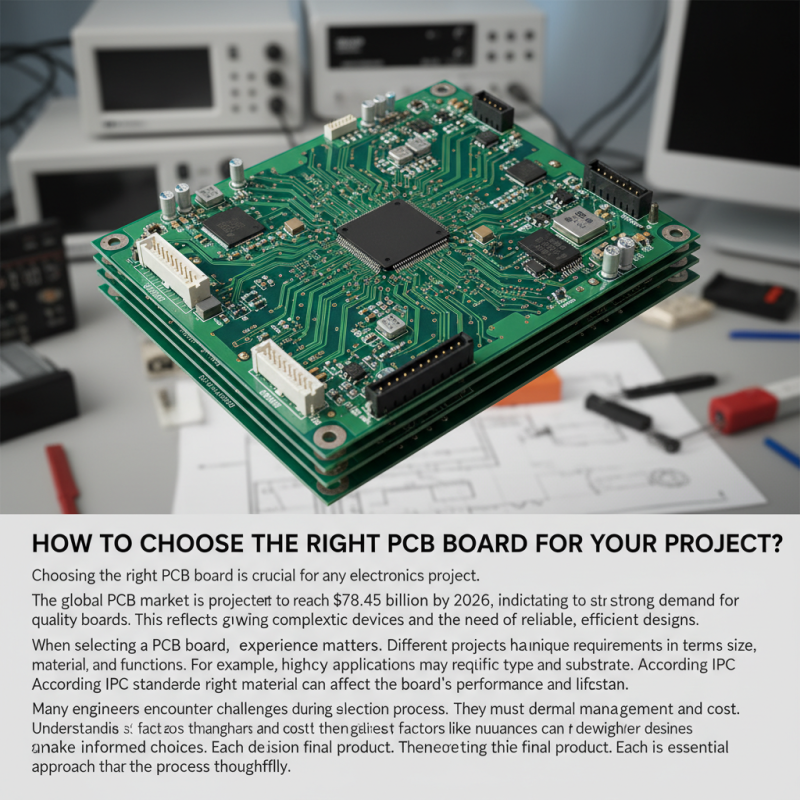
When selecting a PCB board for your project, understanding the various types available is essential. The two most common types are single-sided and double-sided PCBs. Single-sided boards have components on one side only, making them simpler and cost-effective. They work well for basic applications, but they lack the complexity needed for advanced projects. Double-sided boards allow components on both sides, providing flexibility and enabling more intricate designs.
Another important category is multi-layer PCBs. These boards consist of more than two layers. They are ideal for high-density applications where space is limited. Multi-layer boards allow for complex routing and more sophisticated circuitry. However, they come at a higher manufacturing cost and can be challenging to design.
Flexible PCBs are also gaining popularity. They can bend and twist, which is beneficial for compact and portable devices. However, their production can require specialized techniques. Choosing the right type involves assessing the complexity of your design and budget constraints. Each type has its advantages and limitations, so understanding your project needs is crucial for a successful outcome.
When selecting a PCB board, understanding your project requirements is crucial. You'll need to evaluate power, size, and component type. Start by determining the voltage and current ratings. This will guide you on the board's thickness and material choice. For instance, high-power projects may need thicker copper layers to manage heat better. If your design is compact, consider multi-layer PCBs to save space without compromising functionality.
Next, think about the environment. Will the board be exposed to moisture or temperature extremes? In such cases, a robust surface finish is essential. Another aspect is the signal integrity; high-frequency applications may require controlled impedance. Additionally, plan for manufacturability. Some designs may look good on paper but are difficult to produce efficiently. It's essential to balance creativity with practicality while designing your PCB. Remember, a design that doesn't consider these factors may lead to costly revisions later. Reflect on what works and what doesn’t.
Choosing the right PCB material and thickness is crucial for your project's success. The material affects conductivity, thermal management, and overall performance. Common materials include FR-4 and polyimide. FR-4 offers good electrical insulation and is cost-effective. On the other hand, polyimide withstands higher temperatures and provides better flexibility.
Thickness is another key factor. A standard thickness ranges from 0.2 mm to 3.2 mm. Thicker boards can handle higher currents but may be less flexible. Consider the design's requirements when selecting thickness. Too thin may lead to failure, while overly thick might add unnecessary weight.
It's important to test different materials and thicknesses if unsure. Prototyping models can highlight potential issues early on. Balancing performance and cost with the right PCB choice can be challenging. Reflect on the project's needs regularly to make adjustments.
Assessing design complexity is crucial when selecting a PCB board. Simpler circuits allow for more straightforward designs, while complex circuits require careful planning. Consider the number of layers needed based on the components and features of your project. For high-density components, a multi-layer PCB might be necessary.
Tips: Always analyze your circuit's requirements first. Know the power, signals, and size of your components. This early assessment can guide your decision.
Another factor is routing complexity. High-speed signals might need specific routing techniques to avoid interference. Look into the types of vias and traces. The PCB thickness also plays a role, as certain projects may require added rigidity.
Tips: Do not overlook thermal management. Components generating heat may need extra consideration in design. Ensure that your PCB can handle the thermal load effectively. Small adjustments early can save significant issues later.
Choosing the right PCB board significantly affects project success. Budget considerations play a crucial role in this decision. A report by IPC states that PCB costs can represent up to 30% of the total product cost. Thus, understanding how cost influences selection is essential for effective project management.
When assessing PCB options, it's vital to balance quality and cost. Cheaper materials might compromise board performance. A study from ResearchAndMarkets indicates that high-performance PCBs can boost reliability but may increase the budget by 20-50%. Conversely, low-cost boards can lead to premature failures, resulting in higher long-term costs due to repairs or replacements.
Tips: Focus on your project's specific requirements. A clearly defined need can prevent overspending. Consider production volume and complexity when budgeting. Large quantities can reduce per-unit costs, making premium options more viable. Don't hesitate to explore different materials or designs. Sometimes, minor adjustments can lead to significant savings.
| PCB Type | Material | Layer Count | Cost per Unit ($) | Lead Time (days) |
|---|---|---|---|---|
| Single-Sided | FR-4 | 1 | 2.00 | 5 |
| Double-Sided | FR-4 | 2 | 3.50 | 7 |
| Multilayer | FR-4 | 4 | 5.00 | 10 |
| Aluminum | Aluminum | 1 | 6.00 | 15 |
| High-Frequency | PTFE | 2 | 8.00 | 20 |