
China’s steel industry supports a wide range of energy, construction, and water-well projects. Within this supply chain, Steel Casing Pipe remains a critical product. It protects boreholes, supports formation stability, and helps maintain safe fluid movement underground.
As tubular-products engineer Sun Zhaoliang observes, “A casing pipe is only as reliable as its weakest connection.” This practical view matters when comparing China’s leading manufacturers for 2026. A strong factory must offer more than competitive pricing. It should demonstrate controlled steel chemistry, consistent wall thickness, accurate threading, and dependable non-destructive testing. API 5CT compliance is important, but certificates alone do not tell the complete story.
Field experience also deserves attention. Engineers often inspect pipe ends, thread protectors, coating quality, and loading methods before shipment. Small damage during handling can create expensive problems later. It happens.
This ranking examines ten Chinese manufacturers through production capacity, product range, quality systems, export experience, and technical support. It also considers whether each supplier can provide practical documentation, traceable inspection records, and stable delivery performance. Some companies appear impressive online but offer limited evidence of actual project experience. That gap deserves careful reflection.
The selected manufacturers serve different market needs. Some focus on oil and gas casing. Others specialize in water wells, geothermal drilling, piling, or custom specifications. Buyers should match supplier capability with operating conditions, steel grade, connection type, and installation method. No single manufacturer is ideal for every project.
This guide is designed for procurement teams, drilling contractors, engineers, and international buyers seeking a clearer view of China’s Steel Casing Pipe market in 2026. Availability can change, so independent verification remains necessary.
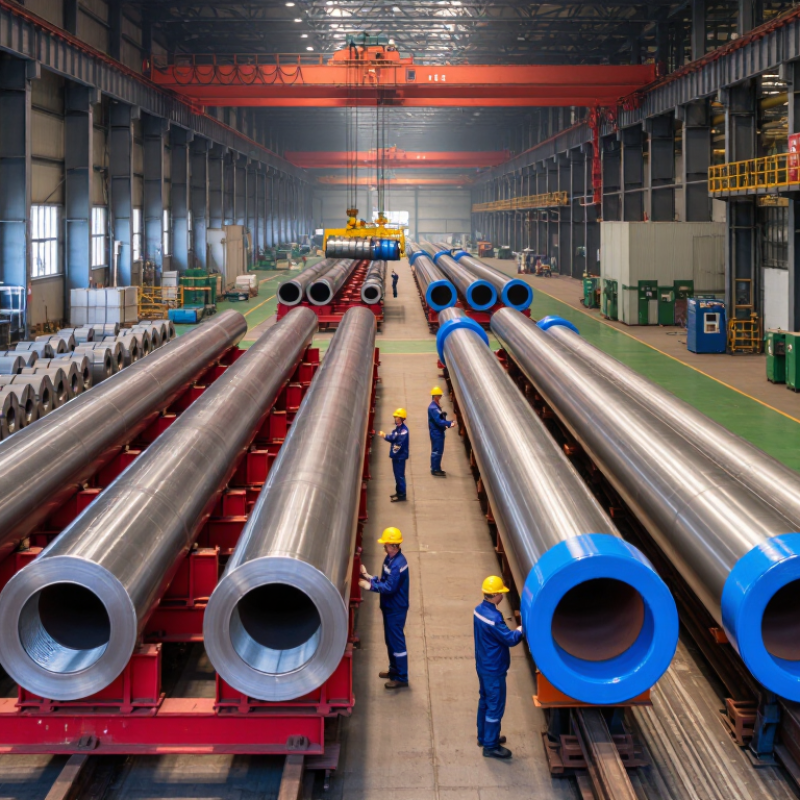
Steel casing pipe is a heavy-duty steel tube installed around another pipe, cable, or borehole. It provides structural support and reduces damage from soil pressure, traffic loads, water movement, and accidental impact. In utility projects, crews often place it beneath roads, railways, and drainage channels. In wells, casing stabilizes the borehole and helps separate underground formations.
Not just a hollow tube. Its performance depends on outside diameter, wall thickness, steel grade, length, straightness, and end condition. Common connections include plain ends, beveled ends, threaded joints, and welded joints. Coatings may improve resistance to corrosion, but coating choice must match soil chemistry and installation conditions. A specification copied from another project can be unsuitable.
Field inspections should check ovality, dents, weld quality, and dimensional tolerance before shipment. During installation, workers should control alignment and avoid excessive pushing force. Pipe weight also affects lifting equipment and transport planning. Project standards may reference ASTM, API, EN, or local requirements, but the correct standard depends on the application. I have seen technically strong orders fail because soil data was missing. That detail matters. Conservative wall thickness may increase cost, while insufficient thickness can create deformation during boring. Engineers should verify loads, installation method, service life, and inspection records before approving production.
Steel casing pipe is a high-strength tubular product installed in drilled wells to support the borehole, isolate geological formations, protect groundwater, and provide a pressure-controlled path for drilling and production operations. The specifications below summarize commonly used oilfield casing configurations and are based on widely recognized API 5CT dimensional and material practices.
| No. | Casing Function | Typical Outside Diameter | Representative Wall Thickness | Common Steel Grade | Typical Connection | Primary Use | Key Specification Consideration |
|---|---|---|---|---|---|---|---|
| 1 | Conductor Casing | 20 in (508.0 mm) | 0.500–0.635 in (12.70–16.13 mm) | J55 or equivalent | Welded, threaded, or special conductor connection | Supports the upper wellbore and prevents loose surface formations from collapsing. | High structural stiffness, impact resistance, and suitability for shallow installation methods. |
| 2 | Surface Casing | 13 3/8 in (339.7 mm) | 0.330–0.514 in (8.38–13.06 mm) | J55 or K55 | API BTC, LTC, or premium connection | Protects freshwater zones and provides the foundation for wellhead and blowout-prevention equipment. | Collapse resistance, cementing performance, and pressure integrity are critical. |
| 3 | Intermediate Casing | 9 5/8 in (244.5 mm) | 0.352–0.545 in (8.94–13.84 mm) | K55 or N80 | API LTC, BTC, or premium connection | Isolates unstable formations, lost-circulation zones, and abnormal-pressure intervals. | Combined burst and collapse strength should match the anticipated drilling window. |
| 4 | Production Casing | 7 in (177.8 mm) | 0.272–0.453 in (6.91–11.51 mm) | N80 or L80 | API BTC or premium gas-tight connection | Forms the main pressure barrier around the production interval. | Material toughness, internal pressure rating, and connection sealing are important. |
| 5 | Production Casing | 5 1/2 in (139.7 mm) | 0.275–0.415 in (6.98–10.54 mm) | N80 or P110 | API LTC, BTC, or premium connection | Used where a smaller production bore is preferred for conventional or directional wells. | High yield strength can support deeper settings and higher differential pressure. |
| 6 | Liner Casing | 7 in (177.8 mm) | 0.317–0.453 in (8.05–11.51 mm) | N80, L80, or P110 | Threaded liner hanger and liner-top packer | Extends casing coverage without running a full string back to the surface. | Hanger load capacity, overlap length, and liner-top seal performance require verification. |
| 7 | High-Strength Casing | 5 1/2 in (139.7 mm) | 0.361–0.476 in (9.17–12.09 mm) | P110 or Q125 | Premium connection commonly selected | Deep, high-pressure, and high-temperature wells requiring enhanced mechanical strength. | Connection efficiency, sulfide-stress-cracking requirements, and manufacturing heat treatment must be controlled. |
| 8 | Sour-Service Casing | 7 in (177.8 mm) | 0.362–0.453 in (9.19–11.51 mm) | L80 or qualified sour-service grade | Gas-tight premium or qualified API connection | Used in wells containing hydrogen sulfide or other corrosive sour-gas conditions. | Hardness limits, chemical composition, SSC resistance, and NACE/ISO compliance are essential. |
| 9 | Thermal-Well Casing | 9 5/8 in (244.5 mm) | 0.395–0.545 in (10.03–13.84 mm) | N80 or L80 | API BTC or premium thermal-service connection | Supports steam injection, geothermal, and other wells exposed to elevated temperatures. | Thermal expansion, cement compatibility, corrosion allowance, and connection stability must be evaluated. |
| 10 | Corrosion-Resistant Casing | 4 1/2 in (114.3 mm) | 0.205–0.337 in (5.21–8.56 mm) | L80 or corrosion-resistant alloy option | Premium connection or application-specific threaded connection | Used for corrosive production fluids, carbon-dioxide service, and demanding completion environments. | Material selection should consider CO₂, H₂S, chlorides, temperature, pressure, and corrosion-control strategy. |
Note: Actual casing selection depends on well depth, formation pressure, temperature, fluid chemistry, load cases, connection efficiency, cement design, and applicable API 5CT, ISO 11960, NACE, or operator requirements. Outside diameter and wall thickness combinations should be confirmed against the selected product specification and approved design calculations.
This article presents a practical overview of the Steel Casing Pipe industry in China in 2026. It explains the definition, primary applications, construction features, material grades, dimensions, wall thicknesses, connection types, and key performance requirements of casing pipes used in wells, infrastructure, foundations, and other demanding projects. It also examines the overall development of China’s manufacturing sector, including production capacity, technology upgrades, quality management, export capabilities, and market competition.
The ranking of the top 10 Chinese manufacturers is based on objective factors such as product quality, manufacturing experience, certification systems, delivery capacity, customization services, testing procedures, and international supply performance. In addition to introducing the selection framework, the article provides guidance for evaluating suppliers, comparing technical specifications, verifying quality documents, reviewing production capabilities, assessing communication and after-sales support, and choosing a reliable partner according to project requirements, budget, delivery schedule, and applicable standards.